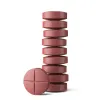

A “5% mesembrine” statement on a kanna extract tablet is a composition claim, not a second serving-size number. To interpret it, you need the amount of extract to which the percentage applies and clear wording that identifies mesembrine as the stated constituent.
A simple label calculation
If a tablet lists 150 mg of kanna extract standardized to 5% mesembrine, multiplying 150 mg by 0.05 gives 7.5 mg as the mathematical amount represented by that specification. The calculation is valid only when the percentage applies to that 150 mg extract. It should not be applied to tablet weight, package weight, or a different blend component.
The percentage may represent a target, minimum, or tested result depending on the manufacturer's wording and documentation. The front label alone may not settle that distinction.
Mesembrine is part of a broader constituent profile
Sceletium tortuosum extracts can include several related alkaloids. Scientific literature, including a review of mesembrine-class alkaloids, discusses multiple constituents rather than treating every extract as mesembrine alone. A single percentage therefore does not describe the complete composition.
What 5% does not prove
- It does not show that two extracts use the same process.
- It does not describe every alkaloid in the extract.
- It does not convert a product label into evidence of an outcome.
- It does not establish that a higher percentage is the better match for a shopper.
Compare like with like
For two products, record the extract milligrams, percentage basis, amount per serving, tablet count, and whether the formula contains other actives. If one product states total alkaloids and another states mesembrine, keep those specifications in separate columns. They answer different questions.
Then check whether a batch-specific document or manufacturer specification supports the label language. That is more informative than comparing product names alone.
The 150 mg kanna extract tablet listing provides a concrete Simply Tabs example for practicing this label-first comparison.