
7-Hydroxy-mitragynine — usually called 7-OH — is a naturally occurring terpenoid indole alkaloid present in trace amounts in the leaves of Mitragyna speciosa, a tropical tree indigenous to Southeast Asia. First identified in 1994, it has attracted scientific interest because of its close chemical similarity to mitragynine, the plant’s dominant alkaloid, and the difficulty of obtaining significant quantities of it. While 7-OH has become popular with many adults — particularly in the form of 7-Hydroxy tablets — most people aren’t familiar with exactly how it is made. So, how is 7-Hydroxy produced?
Mitragyna Speciosa: A Historical Background
Mitragyna speciosa grows in regions like Thailand, Indonesia, Malaysia, Myanmar, and Papua New Guinea. Botanists first cataloged the tree in the 1800s, noting its evergreen leaves and prevalence across its native range. Although the leaves have been used traditionally for generations, the specific identification of 7-OH as a distinct alkaloid didn’t happen until much more recently. In 1994, researchers documented the isolation of 7-OH from the plant’s leaves, as reported in the Journal of Pharmacology. This finding expanded the known chemical makeup of M. speciosa and spurred further study into how it occurs and can be produced.
7-Hydroxy: A Scientific Background
7-OH belongs to the broader family of terpenoid indole alkaloids, a class of molecules built from tryptamine and monoterpene units. Chemically, it closely resembles mitragynine but has a hydroxyl group attached at the 7-position on the indole ring, which makes it distinct. In unprocessed plant material, 7-OH makes up under 2% of the total alkaloid content of M. speciosa leaves. Research suggests that it may be formed through oxidative reactions acting on mitragynine, either through enzymatic mechanisms inside the plant or through environmental influences — pathways that have inspired laboratory methods to reproduce this transformation.
Natural Occurrence in Plants
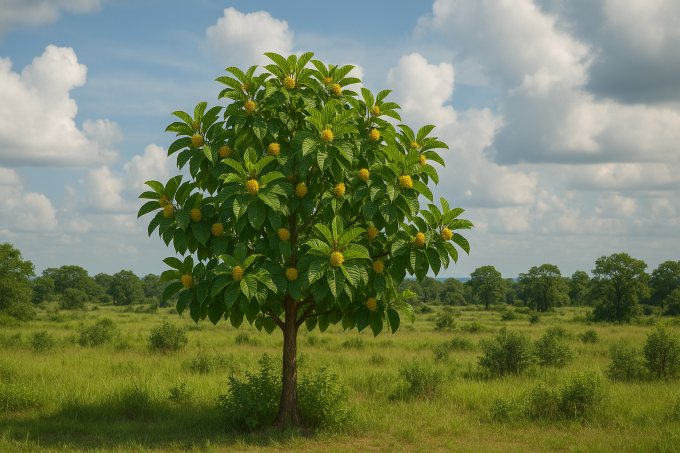
Mitragyna speciosa flourishes in warm, humid tropical climates, and environmental variables like soil type, rainfall, and timing of harvest can affect its overall alkaloid content. While older leaves often yield more total alkaloids than younger ones, the proportion of 7-OH remains low even under ideal conditions. Analyses show that extracts from the plant still contain only minute quantities of 7-OH — often around 1–2% of the total alkaloid fraction — which is why extracting it directly from plant material isn’t practical for most purposes.
Laboratory Derivation Processes: How 7-OH Is Made
Because direct isolation from kratom leaves produces such limited yields, most commercially used 7-OH begins with mitragynine that has been extracted from M. speciosa. A widely studied semi-synthetic method selectively oxidizes mitragynine in a mixture of tetrahydrofuran and water using bis(trifluoroacetoxy)iodobenzene (PIFA) at near-freezing temperatures under an inert atmosphere. This targeted oxidation alters the indole ring to form 7-OH, which is then purified by column chromatography.
In addition to conventional chemical oxidations, innovative techniques have emerged. For example, electrical breakdown-in-liquid (EBL) reactors expose powdered kratom in suspension to a plasma discharge, triggering advanced oxidation processes that convert mitragynine into 7-OH without using traditional oxidizing agents. Beyond semi-synthetic conversion, researchers have also demonstrated complete laboratory syntheses of 7-OH starting from simple, commercially available chemicals. One published 12-step asymmetric total synthesis achieved more than an 11% overall yield and showed that 7-OH can be built entirely in a controlled lab setting.
Purification and Analytical Verification
After synthesis or conversion, 7-OH must be separated from other alkaloids and side products. Techniques such as centrifugal partition chromatography (CPC) are often used first to remove bulk impurities, followed by high-performance liquid chromatography (HPLC) to achieve refined purity. These methods are particularly effective at removing residual mitragynine and closely related molecules. To confirm structure and purity, advanced analytical tools are employed: high-resolution mass spectrometry verifies molecular weight, nuclear magnetic resonance (NMR) spectroscopy maps atomic connectivity, and UV detection with HPLC provides quantitative data. Many laboratories, including those that test products at Simply Tabs, combine these methods to ensure reliable results.
How 7-OH Is Made: In Conclusion
First isolated from Mitragyna speciosa in 1994, 7-Hydroxy-mitragynine remains a valuable and intriguing natural product in chemical research. Its scarcity in raw plant material has driven the development of various laboratory production methods — from targeted oxidation of mitragynine to total synthetic construction — that allow for usable quantities to be obtained. Purification and analytical verification ensure the integrity of the final compound. Today, the creation of 7-OH represents a blend of traditional botanical understanding and modern chemical innovation, connecting nature’s complexity with rigorous laboratory science.